Showing posts with label Big Piney. Show all posts

Thursday, March 26, 2009

Rachel Anderson Scherbel


There are places I go in my dreams, when I can't get there in real life. If I close my eyes, I can leave the home of my childhood in the tiny little town of 500 people, cattle and oil, in southwest Wyoming, and wander two blocks up the street to the corner where the drug and hardware store were, turn left down the main street, past the post office and library, the florist, and the old Gaiety Theater, and turn right at the grocery store, Burney & Company. The main street, the only paved road in my childhood, makes a couple of switch turns until it comes to the place where I went to high school.

And right across the street, was the Scherbel home.

The Scherbel home was the first home I remember being in as a child, other than my own, and my grandparents' next door, growing up in Big Piney, Wyoming. Paul Scherbel was the County Surveyor, and he and his wife, Rachel, had four children, a son Paul A., daughter Annette, and two sons Scott and Marlowe who were closer to my age. Rachel and my mother took turns babysitting for each other when I was younger, and I would go over and stay and play with Marlowe in their enormously warm, comforting and fascinating home, central to which was a wood-burning stove in the kitchen. It was the first wood/coal-burning cooking device I'd ever seen in a kitchen, since we cooked with gas. There was a comfy banquette in the corner of the room near the stove, and conspicuously absent from the home was a television, any television. As children we knew that the Scherbels didn't eat cold cereal like lots of other kids did, and they didn't watch, or own, a television. But somehow we didn't really feel sorry for them, because they were extraordinary kids. The boys were all Eagle Scouts, exemplary in the community, and leaders in school. The home was well furnished in rust-colored wool carpeting, built-in woodboxes in the livingroom, board games and books and puzzles, things to keep us occupied well into the night when the youth would gather for the end of a progressive dinner over the holidays. They had a wonderful oversized swingset in the backyard, and Annette would push me and Marlowe higher and higher in the swing, overlooking river, and cottonwoods in my mind's eye, ladybugs everywhere. Across the lawn, just steps away, was the surveying office, filled with maps and charts, the smell of mimeograph ink and work, to delight a child's imagination.

In the kitchen were peanut butter and honey sandwiches, glasses of milk, tomato soup, stepstools to be pushed when no one was looking, corners to explore in a child's free time.

The Scherbels are firmly fixed in that childhood memory, from birth through college, swimming trips to Jackson Hole and the Hoback, church trips to Salt Lake City, sitting between Paul and Rachel in the front of their car, dozing off, on the way back from Utah, or riding with Scott on the way home for the weekend from college, hitting a steer on open range on the Cumberland Flat late at night in a Ford Torino, wrapping chains on tires going up Emigration Canyon in the snow, having lunch in Jackson, ending up with Scott in a hospital with tick fever, riding on the back of their tandem bicycle, watching Scott play chess at Scout Camp near New Fork Lake, singing with Marlowe in church about the hills of Tennessee when he returned from his mission there, making homemade ice cream with rock salt in their ice cream freezer, waiting on the steps of the church for Mutual, or getting up at the crack of dawn for early morning Seminary. Which their mother taught.

There was a funeral earlier this week in my hometown of Big Piney, Wyoming, which I wanted to get to, but couldn't, so I'm going there in my dreams.

That funeral was for Rachel.

Rachel Anderson Scherbel.

As much as anyone growing up, Rachel was enormously good to me. Of course, like most children, it took me years to fully appreciate it. As a Seminary teacher she was extraordinary, knew her material, and every morning just after six o'clock. we were all huddled together in the chilly linoleum floored meetinghouse to study it. Now that I think of it, we should have had Seminary in their home; more kids would have attended. But the handful of us high school students who did attend learned a lot from Rachel, more than Scripture Chase, more than the history or theology of the church of our pioneer ancestors.

I think of Rachel always with her fashionable wing-tip heels and pumps, far too fashion forward for rural Wyoming, and her crisp suits, her Katherine Hepburn/Annette Bening good looks, and her New England sensibility. She'd occasionally substitute in the schools when one of our regular teachers was sick. I remember her being a frequent fill-in for my English teacher Harvey Graham. She knew her stuff. She knew how to keep a classroom in order. She commanded respect with her copper well coifed hair, her striking features, her presence.

I knew she had a brother who was a physician in Salt Lake. I'd visited their home once with Scott when for some reason we couldn't get anywhere else. I knew Rachel was well educated, had studied and taught outside the area, places like Cornell, the University of Vermont and the University of Utah, and had a view that extended beyond Big Piney, where her husband Paul N. was frequently mayor, or Sublette County, where they were both well respected, or even the western slice of Wyoming, where their hands and tools had touched much of the landscape, measured and charted it. Other people we knew had worked for Surveyor Scherbel, people like Rulon 'Shrimp' Woffinden and Maurice Zardus. When Annette married, her husband Bob Priddis came to work for Surveyor Scherbel, and later, Scott and Marlowe returned to work with their father as well. Now everyone is gathered back in the area, from Star Valley to Big Piney, continuing the legacy, a legacy that at last count includes 32 grandchildren and 42 great-grandchildren, who combined can speak over 17 languages, and who came to a little church in southwest Wyoming earlier this week to honor her.

I will miss Rachel. And I must pay tribute to her. I don't think of her as much older than I am now, a woman permanently frozen in my mind between her thirties and her fifties, striding confidently into church, well groomed, head held high. Paul N. always made sure everyone found a seat in our little hodgepodge of cold metal folding chairs and hymnbooks, then took his place comfortably in the rear to survey the congregation.

When I was younger, Rachel showed me books to read, and gave me odd jobs, like cataloguing them at the church library, to make extra money in a family where money was a more precious commodity than I at that time realized. She'd come frequently to my grandfather's house to borrow the odd book from him that had been acquired at Sam Weller's Bookstore in Salt Lake, or pick his brain. She'd send me notes of encouragement growing up to help me stay focused on what was important. She gave me a copy of 'W' magazine that had the most obscure article on "Quality" in it, and the notion and meaning of quality as it related to aesthetics. That single act had a more profound influence on me than most people will ever know or appreciate, as it came at a time in my own formative consciousness where being able to discern things of quality, and sharpen a critical eye, was important. Wool carpet. Parquet floor.

Rachel was a person of quality, a force of nature, a beloved wife, a revered mother, a cherished grandmother, a treasured friend, mentor and teacher. She will always remain in that place in my dreams, making ice cream, and sandwiches, walking into church, or school, arms around us all.

Sunday, March 1, 2009

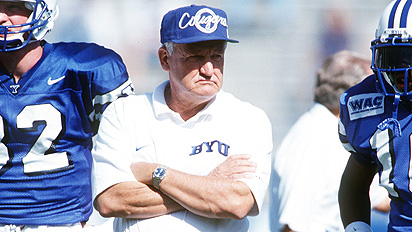
LaVell Edwards


At the corner of US Highway 189 and the main street in my hometown of Big Piney, Wyoming, there's a garage that opened in 1912 or thereabouts, when only two motorcars had even made their way to that particular corner of the sagebrush, A. W. Smith's Pierce Arrow and Gull Whitman's Ford.

In its strategic location at the corner of the two most important roads in the community, it served a growing population of those who'd given up four-legged transportation for that powered by the treasured fossil fuels under their feet.

Along the way, one of the proprietors of the Big Piney Garage was Irwin Covey, who'd taken over from Walter Yose, Sr. after he'd taken over from the original owners, Lawrence Bess and Gull Whitman. Along with his wife Louise, he ran what we all affectionately called "Covey's" at 101 Front Street.

At some point, he offered his son-in-law the chance to join him in his business, but his daughter Patti's husband decided to take a teaching job instead in a Utah school district, and the rest, as they say, is history.

La Vell Edwards.

Saying the name "LaVell Edwards" in Utah is like saying the name "Vince Lombardi" in Wisconsin. In 1972 he was offered the head coaching position at BYU football, a role he filled until 2000. At the time of his retirement, the team ranked sixth in all-time victories. He moved the BYU Cougar football program into a passing-dominated game, and had such notable quarterbacks as Jim McMahon and Steve Young under his wing. He completed the 1984 season 13-0, and was named National Coach of the Year that year after he led the Cougars to a National Championship. Prior to his final game in 2000, the BYU football stadium was renamed LaVell Edwards Stadium in his honor.

LaVell could have joined his father-in-law at the garage in Big Piney. But he chose a different path. College football will never be the same.

Saturday, February 7, 2009

Mark Haddock


For most of my childhood, there was only one grocery store in Big Piney. Burney & Company sat at the end of the only paved street in our town, at a curve in the road about a block from the high school, and when I was younger it was dark, with lightbulbs hanging from chains, and a single pot-bellied stove near the center where locals would gather to chew the fat. Thursdays we got produce, lettuce and tomatoes, which we eagerly awaited. Many townspeople charged their groceries for months at a time; the ranchers would come in before snowfall to buy supplies for the winter, and many wouldn't be seen again until spring if things got bad enough. As kids we'd run into Burneys during our school lunch hour and buy candy bars for a nickel and charge them to our parents' accounts.

Then one day, everything changed. The Haddock family moved to town, and decided to open a second grocery store at the other end of the street. There was a community contest to name the new store, and the winning entry became a fixture in our community--Haddock's Food Fair. The Haddocks were from Idaho originally as I recall, and moved into a house just a block down the street from ours toward Highway 189, the main route from Salt Lake City to Jackson Hole, the Tetons, and Yellowstone Park. It might as well have been a million miles from anywhere.

For a child growing up across the street from a power plant, barbed wire fences to keep cattle in and dogs and people out, and the occasional stray moose, there was no life except the constant subverted struggle between cattle and oil, the knowledge that the ranching dynasties of the community tolerated, but often resented, the presence of the more transient members of the community who came in by way of the petroleum industry, many of whom lived in subdivisions created by Belco Oil and El Paso Natural Gas for that purpose.

Because my father worked for a small, independent oil and gas company, we lived in town. We were among the fortunate few.

What I saw from that window was not just the sun rising over the Wind Rivers to the east, but the barbed wire fence across the street to the south, the alley way to the north where we burned garbage and played on propane tanks, and lots and lots of gravel roads, the occasional pine tree, and cottonwoods. Lots of cottonwoods.

For the winds of change to bring anyone else into that setting was something of a miracle. It wasn't just that there was competition in the grocery business. It was that change was coming. It was in the air, on the breeze floating like Forrest Gump's feather.

It was there.

Mark Haddock came on that breeze.

Mark was one of two children the Haddocks had with them when they came to town who were just older than I was, a young teenager at the time blossoming out into a world of possibilities. Mark wasn't a dime-a-dozen cowboy, or a roughneck's son, or a football jock. He was everything that world was not.

He was a drummer.


He belonged to that other-world of the interesting and relevant and not at all mundane, people who thought, and cared about political causes, and listened to music other than KMER, and somehow touched that consciousness beyond small town Wyoming. It was the world that only beamed into my bedroom at night after sunset when we could finally get the radio waves from Oklahoma City--KOMA --bringing the Bee Gees, and Carole King, and Rod Stewart into my store of permanent memory. It was the world I watched on television late at night after the rest of my family had gone to sleep, inhabited by the Dick Cavett Show. Mark dared to have longer hair, and be a musician, and think, and read, and hang out with friends he chose. In another place, he might have been a victim of redneck ignorance, but Mark was very popular and extremely well liked. He played the drums in band and stageband, and was the best drummer I'd ever heard. Ludwig drums and Zildian cymbals. He'd practice for hours, sometimes at the Legion Hall across town, with other musician friends who eventually formed a band. One of the greatest escapes in my life was to listen to that. I could escape the small town, and the four walls around me, and be free.

Mark had a John Cusack wit, and a SNL sense of humor. I loved being around that. I hoped my sensibility was sponge enough to soak up some of it, whether in the back of a school bus coming back from a school trip, or hanging out with his sister, Karen, who became a friend.

To this day I remember a lot of conversations I had with Mark, and many situations involving him, flashes of memory tucked away. He had a beautiful Irish Setter named Major, as I recall--Major Danny Boy Fitzpatrick--who'd run down the road in front of our house. Mark also had a motorcycle, a blue Kawasaki. Larry Vickrey had a similar one, different color maybe. Mark ended up dating a girl from Pinedale, but married a local girl, a few years out of high school. He went on to study music, then acquired several advanced degrees in business. Eventually he settled in Colorado, where he has made his home for the last several years, drumsticks still firmly in hand.


Mark became one of the founding members of the band Due West, and is now drummer for the Walker Williams Band.

Mark Haddock.

Mark was one of the most talented and interesting human beings I had the privilege of knowing, growing up in that small Wyoming town. I always knew he could do anything he wanted. And he did.

Tuesday, August 5, 2008

Marilyn Syra


Marilyn will laugh that I am including her in a blog on famous people, but she seems to have made her mark.

I remember, as though it were yesterday, growing up with Marilyn. From elementary school through high school graduation, she was a classmate and good friend. I especially remember convincing her to take up playing the flute, something I began in fifth grade with only moderate success. I wanted a friend of mine to also play, so I talked her into learning the instrument, never knowing how well she'd do with it, or how far she'd go in music.

Marilyn thrived on the flute. Literally. She went straight to first chair, while I languished in mediocrity, and then moved on to bassoon my sophomore year of high school, and later tympani. We were together in concert band, stage band, marching band, and choir, all the way through high school graduation. Marilyn did well in solo flute competition and was in the Wyoming All State Band.

I remember early junior high days when we'd listen to whatever latest Monkees album over and over, memorizing all the songs. Some weekends I'd sleep over at the trailer in the oil company subdivision where she lived with her parents. We had some great times.

I lost track of Marilyn for an extended period after high school. We went off in different directions, both of us to college. She declared a major in music, and I studied design and philosophy. Fortunately, she took the musical experiences we had growing up in Big Piney and made a difference in the lives of others with that.

Marilyn Syra.

Marilyn is now the band director at Tooele High School in Tooele, Utah, a position she has held for sixteen years, leading the concert, jazz and marching bands. She is beloved by her students and I have no doubt is an outstanding educator and mentor to them.

Tuesday, July 15, 2008

Susan Cook Northway


Susan Anne Cook Northway was my vocal music teacher in high school. She arrived the first day of my freshman year at Big Piney High School, along with her husband, Ernie Northway, who taught instrumental music, band and stageband.

Susan Cook Northway.

In addition to leading the concert choir, Susan Northway taught art, and had a great talent for it. She had a sister who was a professional artist, and Susan's own talents in that department were apparent. As I did with her husband, I learned many things from Susan Northway, and particularly honed my skills in music appreciation and listening. When I wasn't singing in the high school choir, groups or solos, I was accompanying them. I still have a little statuette on my piano in Wisconsin that says "Frederick Chopin Piano Award," an award she dubiously bestowed upon me in high school in the absence of any great talent on that score. My piano skills were serviceable, nothing more, but I enjoyed my time at a keyboard, as I enjoyed singing.

I remember well the day she said to me that I was clearly a generalist and not a specialist, sort of good at a number of things but not particularly excelling in any of them. It was true my interests were broad and the energy and tunnel vision required to single in on one of them was lacking. But there are many things if I could go back and repeat those years in high school now I would do differently with the three decades of hindsight.

I got to know Susan Northway outside the classroom particularly when she had her first child, and I babysat for them briefly after my high school graduation. They lived in the "teacherages" then, school district supplied housing across from the high school, and I still remember her list of phone numbers for Poison Control near the telephone, sitting on her front stoop, and visiting with her in her livingroom as she explained to me about liturgical calendars. (Susan and Ernie had come to Big Piney as Unitarians from Iowa, not particularly religious that I could detect, but as time progressed she seemed increasingly involved with the local Episcopal Church and its trappings, and my only introduction to liturgy in that sense was being included with other high school choir members in participation in its midnight service on Christmas Eve.)

I also remember, the summer after my freshman year of college, being asked by her to model for a drawing class that was doing live modeling near Pinedale. I was supposed to wear a leotard, I was told, so I showed up in the only leotard I had--a black one, only to be told later that it should have been flesh colored. If there were flesh colored leotards to be had in all the state of Wyoming at the time, it would be news to me. In any case, my picture was sketched by several there, and my modesty was intact.

Susan and Ernie Northway later moved to Salt Lake City, where they taught in the local schools and raised a family.

She is now Director of the Office of Religious Education for the Catholic Diocese of Salt Lake City, after several years of teaching religion in two local Catholic high schools.

My first introduction to liturgical music came at the hands of Susan Northway in high school choir, although I didn't realize or fully appreciate it at the time, a Unitarian from Iowa in her late 20's with long red hair, braces, short skirts and fishnet stockings who clearly had an aptitude for the divine, as I did, beyond the great appeal of smells and bells.

Sunday, July 13, 2008

William T. Close, M.D.


A country doctor from Connecticut by way of Africa, William T. Close, M.D. came to my hometown of Big Piney, Wyoming, with his wife in 1977 to establish a rural medical practice.

"Rural" doesn't quite describe it. For much of my childhood, Big Piney didn't even have a doctor, unless you count Dr. Burgoon, who was always over playing cards across town and had a dubious medical license. The closest small hospitals were 90 miles away in Jackson or 120 miles away in Evanston, and the closest medical centers of any significance for serious illnesses and injuries were four hours away in Salt Lake City.

Dr. Close had left Africa in 1977 and settled in Big Piney while I was a state away attending college at BYU, ostensibly "to retire," as we understood it, but it was clear he planned to do anything but. He changed the landscape of a community.

More importantly, he arrived just in time to be on the scene when my father, and our family, needed him most, as a persistent backache in early 1979 led my otherwise healthy, athletic 48-year-old father who worked supervising oil fields for a small independent oil and gas company to see a doctor. Dr. Close, in his wisdom, referred my father to a surgeon in Salt Lake City, Dr. Lawrence Stevens, and in the whirlwind that ensued, my father had surgery to remove tumors from his abdomen and spine which were later diagnosed as the progression of malignant melanoma.

We were only about ninety days from diagnosis to my father's untimely death from the disease, a progressive nightmare that enveloped our entire family and held my father in the chains of unspeakable pain and suffering, but Dr. Close was there, in Big Piney, to offer sensitive, appropriate palliative care during the times my father wasn't in Salt Lake City being treated or hospitalized at LDS Hospital. He did the unheard of. He made house calls. Sometimes he brought his daughter, visiting from out of town, with him.

I hadn't had a lot of personal contact with Dr. Close myself prior to that, as I was most of the time away at school, but I do recall a time I went to see him over Christmas break with a persistent bronchitis. He talked to me about stress, about trying to do too much, about burning the candle at both ends, an easy trap of the college student, and then told me about his daughter, and how in many ways she was the same way, and I reminded him of her.

It would be five more years before Glenn Close was a household name, following her performances in "The World According to Garp" and "The Big Chill." We didn't know much about Dr. Close's daughter then, maybe that she was an actress, but once her image became emblazoned across the screen and the world consciousness in roles like that of Michael Douglas' stalker in "Fatal Attraction," no one would soon forget.

In 1988, taken with the local community that her parents had embraced, Glenn Close made a documentary for the BBC and HBO Films, "Do You Mean There Are Still Real Cowboys?" The film, narrated by Robert Redford, who also has connections to Big Piney (an alternate version was narrated by Glenn Close), explores the lives of several ranching families in Big Piney and the apparent disappearance of the American cowboy from the national stage. It subsquently ran on television as part of the PBS series, "The American Experience."

Dr. Close still practices medicine in Big Piney, where he lives with his wife, Bettine, and still continues to look after the elderly, the infirm, and the dying. Last I heard, his daughter is building a home there. He hasn't yet retired, and it's doubtful he ever full will. He's been honored by many over the years for his dedication to practicing rural medicine in an area of the world particularly challenged by geography and climate, and has published a number of books on his life and experiences (his book, "A Doctor's Life," sits on the nightstand in a guest bedroom at my cottage). He is well regarded as a local citizen and author, and a citizen of the planet, someone who has made a difference.

William Taliaferro Close.

Mike Thomas


Mike Thomas was the cutest guy in the third grade. He was probably the first guy, other than my first cousin, on whom I ever consciously had a bona fide crush. Everyone liked him. He lived across town with his father, the local game warden, and his mother, an artist, and an older sister.

At an early age it was clear he had his own share of artistic talent. His mother occasionally came to our school to teach us about drawing, perspective, and share some of her life work with us. His father's life working for Wyoming Fish and Wildlife as a local game warden, particularly in an area with lots of hunting abuses, was also fascinating.

Mike moved away before we graduated over thirty-five years ago, and I always imagined he'd somehow pursued his art.

He's now one of the premier bronze sculptors of the American West.

D. Michael Thomas.

Those who will be fortunate to own his pieces or have them grace their homes are lucky so-and-sos, indeed.

Saturday, July 12, 2008

Ernie Northway


These days, if you are a serious saxaphone or clarinet player, an Ernie Northway mouthpiece is a prized possession.

Back in the day, Ernie Northway was my high school instrumental music teacher.

Ernest Vernon Northway.

I remember the first day of my freshman year of high school in 1968, when we learned that several new teachers had been hired, among them a husband and wife straight from Drake University in Iowa by way of Las Vegas to teach instrumental and vocal music, respectively. After getting their degrees from Drake they headed to Vegas, where Ernie was a studio musician for headliner shows in the more prominent casinos, something that gave him a unique ability to lead a band in a small town of 500 people in southwestern Wyoming and take its stageband to a position of Intermountain prominence in its class. Apparently Vegas also lended itself to some choreography skills which Ernie was able to use during his time as faculty advisor to the Puncherettes, our high school drill team.


Ernie did me more than one great favor during my years in high school. The summer before my sophomore year, he took a mediocre flute player who'd been unenthusiastically plugging along with the instrument since fifth grade and waved a bassoon in front of her, a beautiful, big, double-reed instrument, and gave her the confidence to learn something new. He introduced that same girl to the works of Hermann Hesse, starting with Steppenwolf and Siddhartha. He taught her how to play tympani when wind instruments no longer held her interest, and how to change the pitch of the individual drums by ear. He had the confidence in her to make her president of the band and have her schedule travel arrangements for out of town trips, including the famous two week school trip to compete in the Reno Jazz Festival in Reno, Nevada. And before she ever went on to play keyboards or electric bass in the stageband, he entrusted her to run the choreographed lights for the spring stageband concert.

Somewhere out there is an audio tape of the stageband concert in the spring of her senior year, which she emceed. "Ham," I recall, were his exact words to describe that unfortunate combining of 16-year-old and microphone. "Primadonna" was another word I won't soon forget escaping his lips during a long and tedious Puncherette rehearsal. Ernie pulled no punches. He encouraged, sometimes he challenged, but in the end, he raised the bar. He changed many lives during his time in Big Piney. I learned a lot about Wheat Thins, Type A personalities and your heart, Bill Chase, Bobby Shew, hotel rooms in Reno, what worked, what didn't, and above all, listening listening listening during that time. "Northway" was what most of us affectionately called him. That he went on to start a business of handcrafting exclusive woodwind mouthpieces that bear his name is most fitting.

He played many instruments, but I remember him best as a trumpet and saxaphone player, in addition to clarinet and flute. Standing in the back of the room with the trumpet section during stageband rehearsals won't soon be forgotten.

Southwest School District #9 brought a number of people to Big Piney for a few years only to move on again later, as the Northways did. The riches of the local petroleum industry allowed for salaries in our school district, and amenities, that would have been unheard of elsewhere. Those of us who were fortunate enough to be students there abundantly benefitted.

Toni Murdock


Tulisse Antoinette "Toni" Onstott was my high school history teacher. When she married a local boy, the cowboy son of a famous ranching family who was at the time working as the school custodian, Mike Murdock, she went from being "Miss Onstott" to "Mrs. Murdock."

Toni Murdock.

I loved the sound of her name, Tulisse Antoinette. Very French. Very exotic. There was a little ditty that some of us wrote in the back of a school bus once coming back from one of many long school trips, probably to a basketball tournament or a music festival, to the tune of the children's song "Alouette, gentille Alouette." Her name fit perfectly to the music.

I remember writing a paper for her on "The Heathen Chinee" (Chinese labor used in southwestern Wyoming on building the Union Pacific Railroad line), and participating in many interesting projects and discussions in her classes, debates on welfare reform, and extended school trips to the State Legislature. I also remember a rather uncomfortable moment getting caught passing a note with a friend and classmate (our desks were in a semicircle at the time), and the aftermath of that insensitive lapse in judgment (to this day, I can recall the contents of that note, and her comments following). I wish I had been more interested in history then. I wish she knew how much more interested I am in it now. Still, she apparently had some faith in me, and I remember well her attendance at my high school graduation, where I was valedictorian, and her congratulating me afterwards with tears in her eyes, apparently moved by my speech which was really distinctive only for its brevity.

( I can still remember the high point of that short speech, a quote by Francoise Hardy: "There are so many dreams beyond your night, and so much sunshine beyond your grey walls, but you can't see it because you stay at home. There is so much sky above your roof. Is your door so old that it won't open, or are you staying at home because you're afraid of catching a chill?")

She gave me a record album as a graduation gift. If I'm not mistaken, it was John Denver, probably "Rocky Mountain High." I was touched by her generosity and her kindness on that occasion, and it occurred to me that whatever misdeeds I'd done in her classroom, she genuinely had an interest in me as a person, and yes, it was possible, thought maybe I had some potential.

I left town two weeks after graduation and headed straight for college, and never looked back. Toni, a New Mexico native with a background in social work and aspirations to go to law school, also left Sublette County and moved onward.

I saw some years back that she had become President of Antioch College in Seattle, and more recently noticed that she is now Chancellor of the entire Antioch University system nationwide, and has found herself in the middle of academic controversy spilling out onto the pages of The New York Times.

Bardy Bardin


Unfortunately the first entry in this blog is dictated by tragic recent events, a young man gone missing in the Wind River Mountains just outside of Pinedale, Wyoming, and the tragic recent discovery of his remains.

Bardy Bardin was a classmate of mine growing up in Big Piney, Wyoming, from grade school until we graduated from Big Piney High School as two of the thirty classmates in the Class of 1973. Bardy was one of those good looking, popular guys that everyone liked. He was an accomplished athlete, a valuable player on many of the sports teams, and participated in a number of other activities. In high school, we were in band, stageband and choir together. He played the trombone in band and stageband, and had a beautiful bass voice that took him all the way to All State Choir. I remember him singing the role of one of the three wise men in a setting of songs from "Amahl and the Night Visitors." He was talented and well liked. All the girls wanted to date him, but his heart eventually went to someone else. Oddly enough, I can still remember the first time I kissed him, at one of those parties famous in Big Piney where everyone pretty much kissed everyone before the night was through so the chances of your getting kissed were pretty good.

The county where we grew up has seen a lot of boom and bust with the petroleum industry in the half century that Bardy and I have been alive. I was reading an interesting article a couple of years ago on that subject in The Washington Post, "Gas is Both Boom, Bane for Wyoming County," when the first four words immediately jumped off the page at me.

Sheriff Wayne "Bardy" Bardin.

"Sheriff Wayne "Bardy" Bardin, who sweeps up criminal fallout from the hottest energy boom in the Rockies, has noticed something new and nasty on barroom floors in his county."


That Bardy had become sheriff of the county, now residing in its somewhat larger (by Wyoming standards) county seat, Pinedale, was not terribly surprising, I suppose. He could have gone on to become a roughneck in the oil fields, and progressed up the ranks of a local energy company, or been a cowboy on one of the local ranches, maybe even had his own, but now he presides over the law enforcement activities in a part of America that is both untamed wild and woolly west and key to the energy resources of our nation and the world. As a result, he ends up in places like The Washington Post.

A more somber headline appeared a couple of weeks ago, when in late June a young Pinedale man, just 24, went missing. A massive search and rescue operation was mounted to search for him, Garrett Wayne Bardin, Bardy's son. The sheriff's department was doing the searching, and the object of the search, sadly, was the sheriff's son. His silver Lincoln Mark LT pick-up truck had been discovered abandoned near Muddy Ridge in the Bridger-Teton National Forest.

Days later, a body was found, in a remote area overlooking the Big Sandy River, and later identified as Garrett Bardin. He was laid to rest on July 9, 2008, after a memorial service at the Pinedale Auditorium, with over 500 people attending.